
It is no longer only an older person's worry
I find myself saying the same thing to younger patients more often than I used to: colorectal cancer, meaning cancer of the colon and rectum (the lower part of your digestive tract), is not just a concern for people in their sixties and seventies anymore. Cases keep climbing in adults well under fifty.
That shift matters because most of us grew up believing this was a disease for a later stage of life. When the story changes, the way we listen to our own bodies has to change with it. As of mid-2026, this is one of the trends I watch most closely.
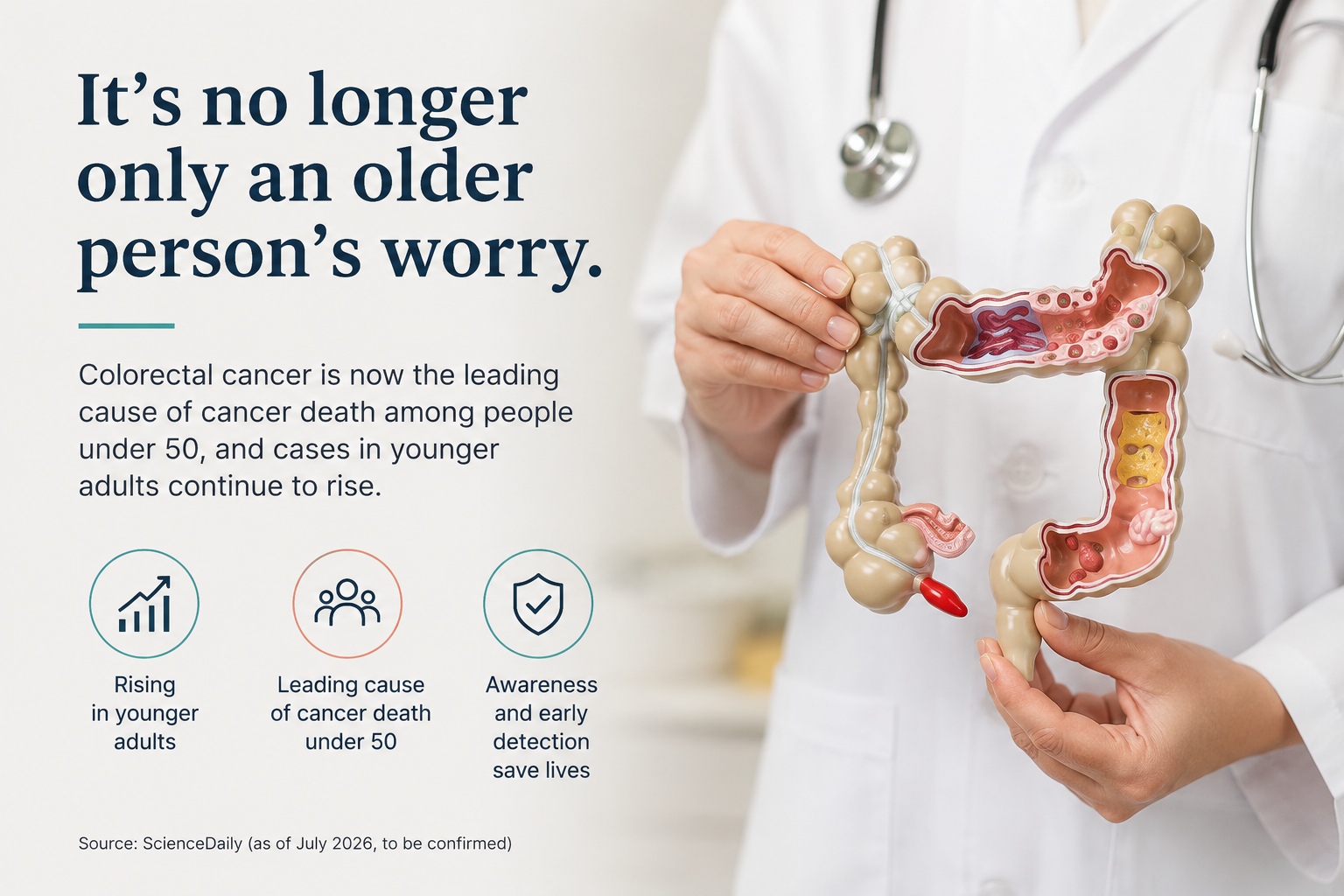
Colorectal cancer is now the leading cause of cancer death among people under 50, and cases in younger adults continue to rise.
Source: ScienceDaily (as of July 2026, to be confirmed)
The signs that deserve a real conversation
Picture someone in their thirties who notices their bathroom habits have quietly shifted and stayed that way for weeks. Not a bad taco Tuesday, but a pattern that will not settle. That kind of persistent change is exactly the sort of thing worth mentioning out loud.
The signals I gently ask people not to brush aside tend to fall into a few groups. Any one of them is often harmless, but a cluster or a stubborn one earns a closer look with your doctor.
-
Bowel changes that linger: a new pattern that holds for weeks rather than days.
-
Rectal bleeding: any blood, even once, even a little.
-
Dark or unusually narrow stools: a change in color or shape.
-
Unexplained weight loss: pounds leaving without you trying.
-
Ongoing fatigue: a tiredness that rest does not fix.
Why the word blood makes us go quiet
Blood is a scary word, and I understand why people stay silent about it. It feels easier to tell yourself it was probably nothing. But here is my honest wish as your physician: I would so much rather hear about rectal bleeding early than never.
More often than not, bleeding traces back to something minor, like irritated tissue rather than anything ominous. That reassurance, though, comes from getting it checked, not from guessing at home. Naming it out loud is one of the kindest things you can do for yourself.
What to carry with you
If something in your body feels off and stays off, treat that as a reason to talk with a provider, not a reason to wait and see. You do not need to diagnose yourself. You only need to notice, and then say something.
I have watched too many people talk themselves out of a simple visit, so let me be direct and warm at once: your worry is valid, your questions are welcome, and an early conversation is never an overreaction. Bring the symptom, bring the timeline, and let us look together.
 |
WRITTEN BY |  |
Call 281-354-2417
Book at www.diversecommunityhc.com
Email Info@diversecommunityhc.com
21693 FM 1314 Rd #400, Porter, TX 77365
Disclaimer
This content is provided for educational and informational purposes only and does not constitute medical advice, diagnosis, or treatment. Reading this article does not establish a physician-patient relationship. Treatment decisions should always be made in consultation with a qualified licensed healthcare professional. If you are experiencing a medical emergency, call 911 immediately.